Down the Rabbit Hole: Hanging Man: The Arrest of Ai Weiwei by Barnaby Martin
Down the Rabbit Hole
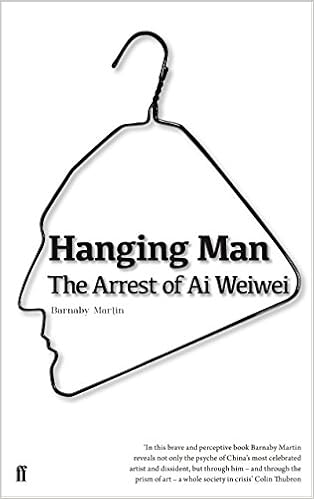
Hanging Man: The Arrest of Ai Weiwei by Barnaby Martin
Almost any time I read an interesting book, I find myself going down rabbit holes: looking up words, tracing down quotes, researching events, concepts, and people - you could call it cross-referencing or simple distraction. I suppose I just do it because I can - I feel that the internet exposes endless nests and warrens beneath the rabbit hole. I almost never do anything with the results of these detours; in fact, I rarely even save the links, let alone any of the information I dredge up.
Yet I realize that the rabbit holes have become the most meaningful part of the experience of reading for me of late, so I feel I should do something with the results of my diversions.
I picked up Hanging Man at the National Gallery of Art because I am interested in China and Ai Weiwei. I thumbed through it and there were some interesting quotes, so I grabbed it. Full disclosure: I wouldn't have bought it if it hadn't been 60% off.
I'm very glad I bought it, and that I cut it to the front of my reading list. I've been reading a lot about asymmetric and next-gen warfare, information war in particular, and Hanging Man was very closely aligned with the other works I'd been reading. It has several concise but very informative sections on the history of art as protest, and on the last century of Chinese politics, dissent, and repression.
Ai Weiwei is the most famous Chinese artist and one of the great dissenters of our time. He was a member of the seminal Stars Art Group (1977-1983), which introduced modern and conceptual art to China. https://www.artsy.net/gene/the-stars-art-group-xing-xing
http://www.zeestone.com/article.php?articleID=16
His work is designed to challenge the way we look at governments, commercialism, globalization, and protest. Some of his most iconic works include:
His work is designed to challenge the way we look at governments, commercialism, globalization, and protest. Some of his most iconic works include:
Dropping a Han Dynasty Urn: A series of photographs of Ai smashing a 2000 year old Chinese vase, then worth several thousand dollars.
Han Dynasty Urn with Coca-Cola Logo: Ai paints the Coca-Cola logo on another 2000 year old Chinese vase. This one gets even more meta, when the owner of this piece has himself photographed smashing the the urn with the Coca-Cola logo in Fragments of History. There is a great discussion on the morality of breaking one-of-a-kind art here.
Just as I was about to move to another of his phases, I saw that someone broke another one of Ai's defaced Han vases to protest the fact that an art gallery decided to only display international art. “If you saw the vases on display and the way they were painted, there was no way one would think the artist had painted over an ancient artifact. Instead I thought it was a common clay pot like you would find at Home Depot, frankly.” Clearly, Ai Weiwei is on to something here - mutilating and smashing valuable artifacts clearly evokes strong feelings about value, ownership, preservation, and history.
Just as I was about to move to another of his phases, I saw that someone broke another one of Ai's defaced Han vases to protest the fact that an art gallery decided to only display international art. “If you saw the vases on display and the way they were painted, there was no way one would think the artist had painted over an ancient artifact. Instead I thought it was a common clay pot like you would find at Home Depot, frankly.” Clearly, Ai Weiwei is on to something here - mutilating and smashing valuable artifacts clearly evokes strong feelings about value, ownership, preservation, and history.
Ai Weiwei quotes from the book:
"I think that any type of revolution in art of literature or in reality is always about how many new concepts are being introduced. And the words are the basis of that. The new vocabulary is the most essential thing. To use new vocabulary means you can really set up new ideas, really expand people's minds - you never just use old words."
"(The Chinese government) are foolish because they miscalculate the situation again and again. They make the wrong evaluation because they don't have the right information. They shut themselves off from the world and that itself is the biggest source of danger because it means they never have the right information. The people around them, the people whose job it is to feed the information into the system, are totally out of touch. So the people making the decisions have a wrong picture about what is going on in the world."
"So today, thanks to the internet, it's harder to be a successful liar and (some big news event) really educates people. The whole nation listens to what the government has to say and then says, 'But this is bullshit.'"
"If the government can do something to me, then they can do something to anybody. My case was so publicized and they were so ruthless and unlawful to me. What about the cases that nobody even notices, that nobody has heard of? That's why I feel it's necessary to clearly explain the situation to other people so we at least get a record. We may never get revenge for these crimes, but at least we have a record of it."
'I think that the only reason for the change is because there is so much more information. So much information happens every day and even with such censorship people can still receive a lot of news from the world. Basically I believe a person is a container of all this information, knowledge, judgments. The state of course is still so strong but the Party cannot limit the information any more. There are too many ways round. And with this information people start to form their own view of the world."
"You're on a boat, on a river, in a valley. Overhead between the cliffs you see a white horse jump the gap and then it's gone. Astonishing! But where has it gone? Why are you in the boat in the valley? Where are you going? You don't know; you will never know. That's life. That's it. The only thing for certain is you saw the horse for that brief second, and it changed the way you felt. That's the only thing..."
Liao Yiwu is considered one of the great modern Chinese political writers. He wrote the poem Massacre https://www.pbs.org/newshour/arts/weekly-poem-massacre in 1989, as an elegy to the victims of the Tiananmen Square massacre. Knowing it would never be published, he released it as a primal dirge and distributed it as an audio tape. I couldn't find a copy of the original, but this version (https://www.youtube.com/watch?v=ySHqtqmdaUk), recorded in the US in 2013, was the purest I could find. The two comments on the video are interesting, too. He was arrested in 1990, sentenced to four years in prison, and released. Broken by imprisonment and torture, and unable to find a job, he became a street musician in Chengdu. During this time, he began interviewing the people he met who, like him, were at the lowest tier of Chinese society: criminals, prostitutes, beggars. The result was entitled The Corpse Walker: Real-Life Stories, China from the Bottom Up.
Barnaby Martin interviews him in Dali, Yunnan province. As a side note, Dali seems to be a very interesting and beautiful town, and is adjacent to the holy Shibaoshan mountain and its spectacular shrines. He finally escaped from China in 2011 and now lives in Germany.
Barnaby Martin interviews him in Dali, Yunnan province. As a side note, Dali seems to be a very interesting and beautiful town, and is adjacent to the holy Shibaoshan mountain and its spectacular shrines. He finally escaped from China in 2011 and now lives in Germany.
"Liao says all he wanted to do... was to describe what he saw around him every day. He wasn't calling for the overthrow of the Party, or demanding for the laws to be changed He is just a historian, a chronicler. A chronicler in cold blood who will say what he sees. But the government hated that so much that they threw him in jail. So then he wrote about what he saw in the jail. That made them even more mad...."
Mang Ke is one of China's most significant living poets, and and accomplished artist. in 1978, he founded Jintian (Chinese: 今天; literally: "Today"), the first non-official literary journal in the People's Republic of China since the 1950s.
Sample of his poetry at https://en.wikiquote.org/wiki/Mang_Ke
Bios are scarce on Mang Ke, here are the most comprehensive I could find in English: http://xichuanpoetry.com/?tag=mang-ke and https://hkrbooks.com/2018/09/20/october-dedications/
"The past is a very perplexing place; it is necessary to be suspicious of the passage of time itself - time in its very essence is cruel, it is radically ironic, and it will always get the better of us if we give it the upper hand. Time is like the wind and we have to stay on its shoulder. If we fail to do so, it will destroy us in a second; time has the capacity to render every human life ridiculous, irrespective of the achievements or past glories of the individual human being. Those people who cling to the past and linger on their stories from long ago are tragic figures - if you fail to let go; if you refuse to recognize that today you are not the same person at all that you were all those years ago, then not only do you become a tragic figure but you also become inhuman."
"All works of art are first and foremost acts of art. The works of art by great artists that come down to us from history are more or less just accidental by-products of the real work, of the superhuman efforts that the artist makes to ensure that their viewpoint is honest, unblemished, and free of outside control. To the initiates into this alchemy, the price that must be paid can sometimes be the ultimate price. For once you have seen the truth, even if for only a second, there is no turning back."
Artists mentioned
Giorgio Morandi - images - https://www.google.com/search?q=morandi+artist&source=lnms&tbm=isch
"For any artist practicing today, perspective or realism in general, is of course a series of conventions. It is not reality. It is a schema and that is all. One schema among many. An orthography that we can choose to use..."Morandi: "I believe there is nothing more surreal and nothing more abstract than reality. What has value in art is an individual way of seeing things: nothing else counts at all."
Ai on Morandi:
"Everything is related to integrity the persistence to believe, to never get confused... We all somehow have to be honest enough to face our condition and of course the artist always is the one who recognizes a certain kind of reality and tries to announce it. You know poets, writers or artists, at first they are the only ones who see it. They have to announce it."Soviet artists
Vladimir Tatlin Images - https://www.google.com/search?q=tatlin&source=lnms&tbm=isch&sa=X
"I think Tatlin had a great imagination. He saw a new world coming. It is a utopian type of thinking, but of course it's all so limited. It's always interesting to look back to some historic moment, to see how people saw the future then, how they imagined it, how they pictured of sculptured the future. And then to compare with what happened."
El Lissitzky another early Soviet artist, images here. Lissitsky is perhaps best-known for his iconic propaganda posters.
"...all those young people, they were very brave and they had strong minds, or strong nerves at least, and they made many manifestos, but later on most of them came to tragic ends."
Chinese history
China is famous for its history of isolation from the rest of the world. This changed briefly in the 1911 Xinhai revolution, when the Qing dynasty was overthrown and a republic was proclaimed on October 10, 1911 (known as "Double Ten Day"). However, the new government was never able to maintain central control of China, leading to regional power vacuums which encouraged the rise of regional warlords. This disorder set the stage for the Communist revolution of 1949. There is still a spirited debate between Mainland China and Taiwan, as both credit the Xinhai revolution as the crucible of their respective political systems.
1921 - Foundation of the Chinese Communist Party
1934-1936 - The famous Long March, a retreat to evade the Chinese Nationalist Party Army.
1949 - Mao Zedong officially takes power over China
1952 - Basic land reform completed. Land deeds destroyed and land redistributed (estimated two million landlords executed).
1957 - Ai Weiwei born in Beijing
1958-1959 - Great Leap Forward. Ai's father, a famous poet and former favorite of Mao, is declared an enemy of the people. The family lived in a pit dug in the ground, Ai's father's job was cleaning the public toilets.
1966-1969 - Cultural Revolution
1976 - Mao Zedong dies
1978-1979 - Beijing Spring. Ai enrolls at Beijing Film Academy. Stars art collective founded.
1981 - Gang of Four trial
1981 - 1993 - Ai lives in New York and studies at Parsons School of Design - discovers Dada and Warhol
1983 - Campaign Against Spiritual Pollution
1989 - Tiananmen Square protests
1995 - Ai's work becomes more radical - Studies of Perspective, Dropping a Han Dynasty Urn
1999 - Ai moves to the Caochangdi studio complex he designed
2005 - Ai begins blogging for Sina Weibo. All his posts have been deleted.
2008 - Sichuan earthquake - Ai advocates for the thousands of victims who are forgotten as part of the cleanup for the Beijing Olympics. Builds an installation from the backpacks of 9000 missing children. Ironically, Ai also designs the iconic "bird's nest" Olympic stadium.
2011 - Ai is arrested by the Chinese police and held for 81 days without being charged. This is the subject of Hanging Man.
China is famous for its history of isolation from the rest of the world. This changed briefly in the 1911 Xinhai revolution, when the Qing dynasty was overthrown and a republic was proclaimed on October 10, 1911 (known as "Double Ten Day"). However, the new government was never able to maintain central control of China, leading to regional power vacuums which encouraged the rise of regional warlords. This disorder set the stage for the Communist revolution of 1949. There is still a spirited debate between Mainland China and Taiwan, as both credit the Xinhai revolution as the crucible of their respective political systems.
"People who have been brought up in the West and have never lived under such conditions are often astonished by the brazenness of Communist or Fascist lies."The personal history of Ai Weiwei parallels that of the Chinese Communist Party
1921 - Foundation of the Chinese Communist Party
1934-1936 - The famous Long March, a retreat to evade the Chinese Nationalist Party Army.
1949 - Mao Zedong officially takes power over China
1952 - Basic land reform completed. Land deeds destroyed and land redistributed (estimated two million landlords executed).
1957 - Ai Weiwei born in Beijing
1958-1959 - Great Leap Forward. Ai's father, a famous poet and former favorite of Mao, is declared an enemy of the people. The family lived in a pit dug in the ground, Ai's father's job was cleaning the public toilets.
1966-1969 - Cultural Revolution
1976 - Mao Zedong dies
1978-1979 - Beijing Spring. Ai enrolls at Beijing Film Academy. Stars art collective founded.
1981 - Gang of Four trial
1981 - 1993 - Ai lives in New York and studies at Parsons School of Design - discovers Dada and Warhol
1983 - Campaign Against Spiritual Pollution
1989 - Tiananmen Square protests
1995 - Ai's work becomes more radical - Studies of Perspective, Dropping a Han Dynasty Urn
1999 - Ai moves to the Caochangdi studio complex he designed
2005 - Ai begins blogging for Sina Weibo. All his posts have been deleted.
2008 - Sichuan earthquake - Ai advocates for the thousands of victims who are forgotten as part of the cleanup for the Beijing Olympics. Builds an installation from the backpacks of 9000 missing children. Ironically, Ai also designs the iconic "bird's nest" Olympic stadium.
2011 - Ai is arrested by the Chinese police and held for 81 days without being charged. This is the subject of Hanging Man.


Comments
Post a Comment